

A December 2025 AARP report landed with numbers that are hard to ignore: 46% of men between 45 and 59 now report feeling lonely. That's up from 35% in 2018, a jump of eleven percentage points in seven years. For context, that's not a blip. That's a sustained structural shift in how a specific group of men are moving through their lives.
The reasons are well-documented but worth naming plainly. Men in this age range are past the years when friendships form automatically, through college dorms, early jobs, or young kids on the same soccer team. The scaffolding that quietly built social life in their 30s has mostly been dismantled. Divorce rates in this cohort remain high. Remote work stripped out the ambient contact that office life provided without anyone having to plan it. And men, statistically, rely more heavily on romantic partners as their primary emotional relationship, which means a breakup or a drifting marriage doesn't just hurt the heart, it often eliminates most of the social fabric at the same time.
The Initiation Problem Nobody Talks About
What the survey numbers don't capture is the specific friction that keeps this group stuck. It's not that these men don't want connection. It's that the mechanics of initiating adult friendship feel either vulnerable or performative in a way that is genuinely uncomfortable at 50 in a way it wasn't at 25. Texting a guy friend to "hang out" can feel like an admission. Planning something formal requires energy and coordination. Showing up at a bar alone reads as sad to some men even if no one else in the room is thinking that. The desire is there. The on-ramp isn't.
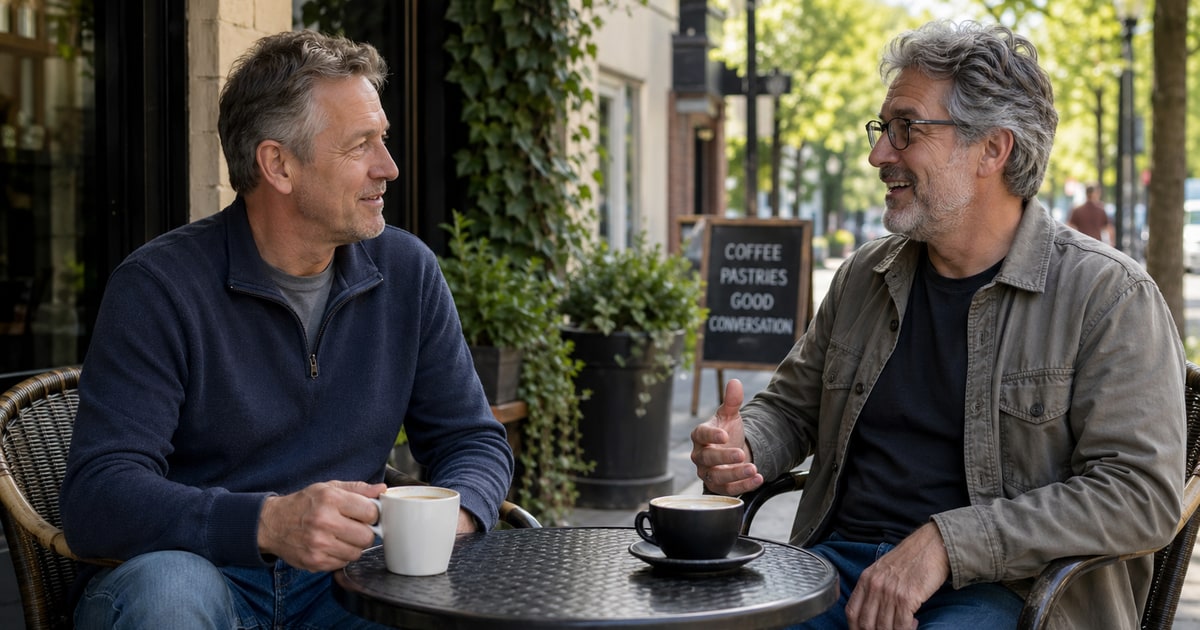
This is where low-stakes, ambient availability becomes interesting as a concept. Rather than pitching a plan to someone, some men are finding that simply being visibly present and open, at a coffee shop with a laptop or a book, removes the social transaction entirely. You're not asking for anything. You're just there. Apps like JavaMe are built around exactly this idea: you post that you're at a specific cafe or library for the next couple of hours, and anyone nearby who's also open to a brief, real-world hello can see that. No scheduling, no obligation, no admission that you're lonely. It's contact without the pitch.
What Actually Moves the Needle
Research on loneliness consistently shows that frequency of contact matters more than depth, at least at first. Weak ties, the acquaintance you nod to at the gym or the guy you sometimes see at the same coffee counter, function as meaningful social buffers even without real friendship behind them. The problem for midlife men is that the environments that generate weak ties naturally are exactly the ones that have thinned out. Offices are emptier. Neighborhoods are quieter during the day. Third places, the cafes, barbershops, and community spaces that urban sociologist Ray Oldenburg wrote about in the late 1980s, are still there, but the habit of actually using them as social infrastructure has eroded.
None of this has an easy fix, and anyone who tells you it does is selling something. But the data from AARP should at minimum reframe how men in this bracket think about their own situation. Feeling isolated at 50 is not a personal failure. It's a predictable outcome of structural changes that have hit this group harder than almost any other. Recognizing that is, at minimum, a more useful starting point than grinding through another solo weekend wondering why the group chat went quiet.